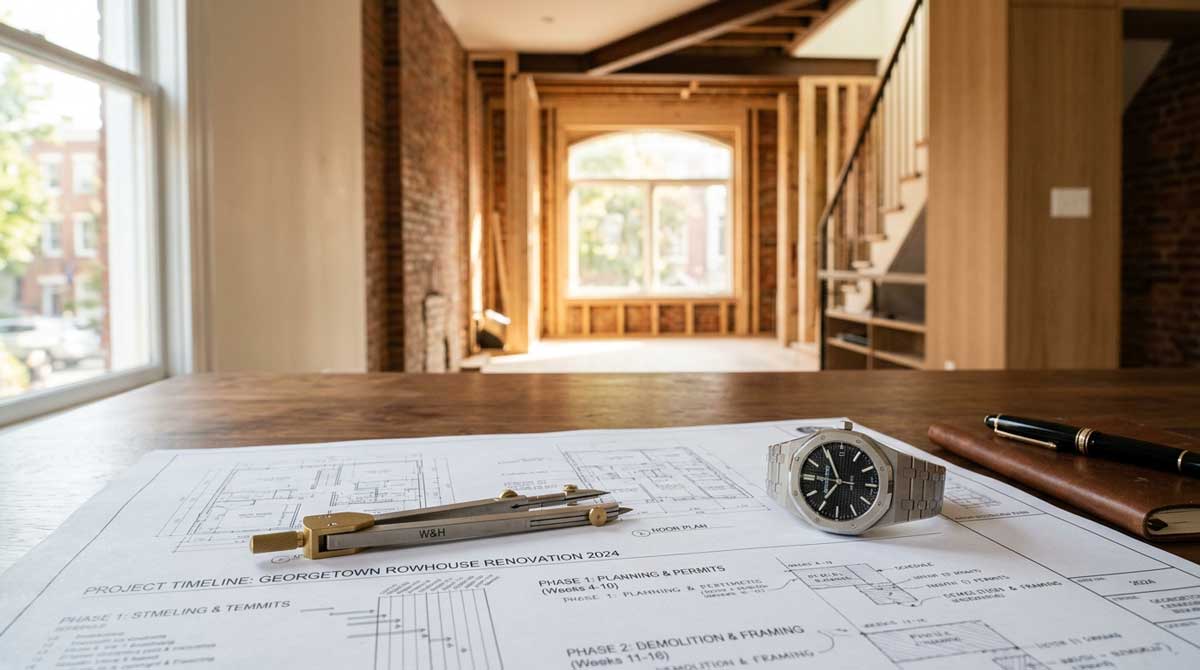
SUMMARY
A full home renovation in Washington DC takes between four and eighteen months, measured from initial consultation to certificate of occupancy. Single-room projects like bathrooms or kitchens run 10 to 28 weeks. Whole-home renovations take 9 to 18 months. The variance comes from project scope, permit complexity, historic district review, and material lead times.
Key Points
- Bathroom remodel: 10 to 16 weeks total (design + construction)
- Kitchen renovation: 16 to 28 weeks total
- Whole-home gut renovation: 9 to 18 months
- DCRA permit review: 4 to 12 weeks for residential work
- Historic district HPRB review adds 6 to 12 weeks
- Begin discovery 8 to 18 months before target completion
What follows is a breakdown by project type, the five phases every DC renovation moves through, and the specific factors that compress or extend a schedule in the District. Written for homeowners who want a clear picture before committing, and for those already in design who need to anchor expectations against reality.
Renovation timelines by project type
In Washington DC, single-room renovations take 6 to 12 weeks of active construction. Multi-room or full-floor projects take 4 to 8 months. Whole-home renovations and additions take 9 to 18 months. These ranges assume design is largely complete before construction begins, and they reflect 2026 conditions including current permit processing times and material lead times.
| Project Type | Design Phase | Construction | Total Timeline |
|---|---|---|---|
| Powder room or half-bath | 3 to 4 weeks | 3 to 5 weeks | 6 to 10 weeks total |
| Full bathroom remodel | 4 to 6 weeks | 5 to 8 weeks | 10 to 16 weeks total |
| Master suite renovation | 6 to 8 weeks | 8 to 12 weeks | 16 to 22 weeks total |
| Kitchen renovation | 6 to 10 weeks | 8 to 14 weeks | 16 to 28 weeks total |
| Basement finish-out | 4 to 8 weeks | 10 to 16 weeks | 16 to 26 weeks total |
| Whole-floor renovation | 8 to 12 weeks | 16 to 28 weeks | 28 to 44 weeks total |
| Whole-home gut renovation | 12 to 18 weeks | 28 to 52 weeks | 40 to 80 weeks (9 to 18 months) |
| Second-story addition | 16 to 24 weeks | 32 to 48 weeks | 48 to 72 weeks (12 to 18 months) |
| Historic rowhouse restoration | 12 to 20 weeks | 24 to 48 weeks | 36 to 68 weeks (varies with HPRB review) |
The ranges above reflect projects where homeowners work with a design-integrated firm. Renovations split across separate architects, designers, and general contractors run 20 to 40 percent longer. Why? Coordination friction. Every phase boundary becomes a handoff. Every handoff becomes a delay. For more on integrated design and construction, see our overview of our renovation services and the residential design process.
The 5 phases of a DC home renovation
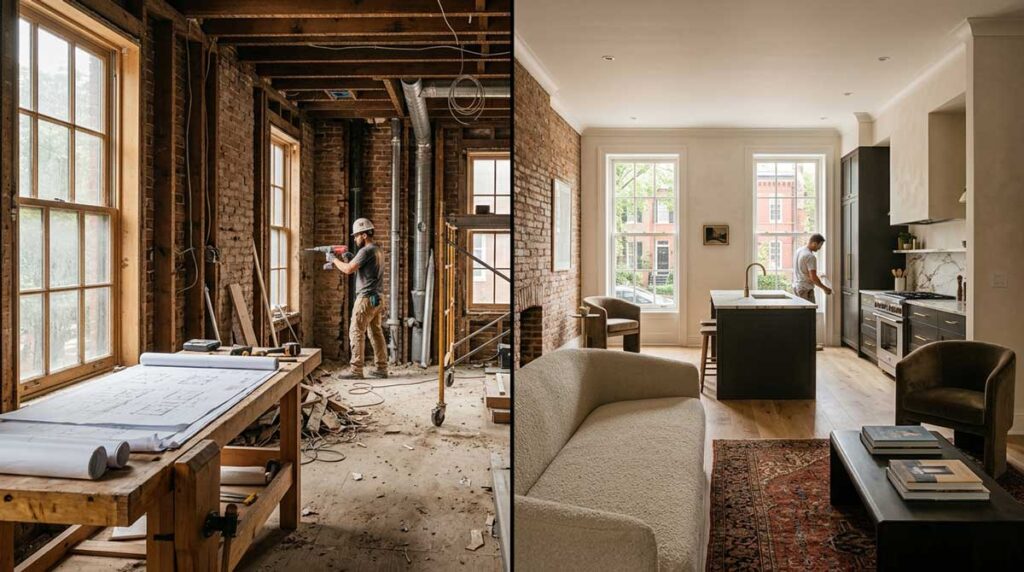
Every renovation in the District, from a powder room refresh to a whole-home overhaul, moves through five sequential phases. Each has a typical duration, a defined deliverable, and a predictable failure mode when rushed.
Phase 1: Discovery and Consultation (1 to 3 weeks)
Phase 2: Schematic Design and Design Development (4 to 12 weeks)
Phase 3: Construction Documents and Permitting (6 to 14 weeks)
Phase 4: Construction (varies by project, see table above)
Demolition first. Then framing. Then mechanical rough-in, drywall, finishes, millwork, and final installation, each in sequence with predictable interdependencies. Construction is the longest phase. It is also the most predictable phase when scope is locked at the end of Phase 3. Mid-project slippage almost always traces to change orders, which are modifications introduced after construction documents were finalized.
Phase 5: Punch List and Closeout (2 to 4 weeks)
Walk-through. Punch list of remaining items. Finish corrections. Certificate of occupancy where required. Handover. Closeout takes longer than most homeowners expect, because the items on a punch list are the small details that determine whether the project feels complete.
What causes DC renovations to take longer than expected
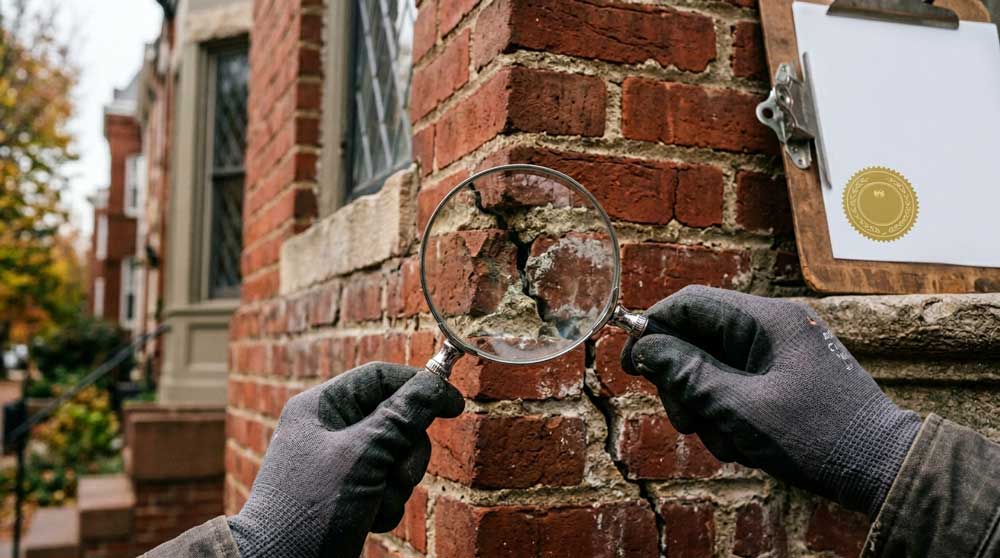
Permit delays. DCRA processing times have varied widely over the past several years. Structural modifications, additions, and projects in historic districts always need longer review. Projects that anticipate this and front-load permit-ready drawings into Phase 3 rarely hit mid-project permitting surprises.
Material lead times. Custom millwork, imported stone, specialty windows, and certain plumbing fixtures can require 12 to 20 weeks. Order finishes during Phase 3, not when construction starts, and you avoid the most common cause of mid-construction stoppage.
Mid-construction change orders. Every change introduced after Phase 3 closes adds time. Sometimes days. Sometimes weeks. The most expensive change orders ripple into adjacent trades: a kitchen layout change that requires re-routing plumbing, which delays drywall, which delays paint, which delays finish installation.
Historic preservation requirements. Properties in Georgetown, Capitol Hill, Kalorama, LeDroit Park, Strivers’ Section, and DC’s other historic districts go through HPRB review on top of standard DCRA permitting. The review adds 6 to 12 weeks. It can also constrain design decisions in ways that send projects back for revisions if not anticipated early.
How to plan your life around a DC renovation timeline
Calendar timing matters too. Permit volume at DCRA peaks in late spring and early fall. Submissions in January or July often clear faster. Material lead times stretch in November and December as holiday shutdowns ripple through supply chains. For projects in Bethesda, Chevy Chase, McLean, and other DMV areas we serve, county-specific permit cadences add another scheduling variable worth coordinating against.
Planning a renovation in Washington DC?
Arch & Handle is an integrated architecture and interior design firm serving Washington DC, Maryland, and Northern Virginia. We design and execute residential, commercial, and hospitality projects with timelines anchored in DC’s specific permitting, historic preservation, and material lead-time realities. To discuss your project and receive a realistic schedule estimate, begin a conversation.