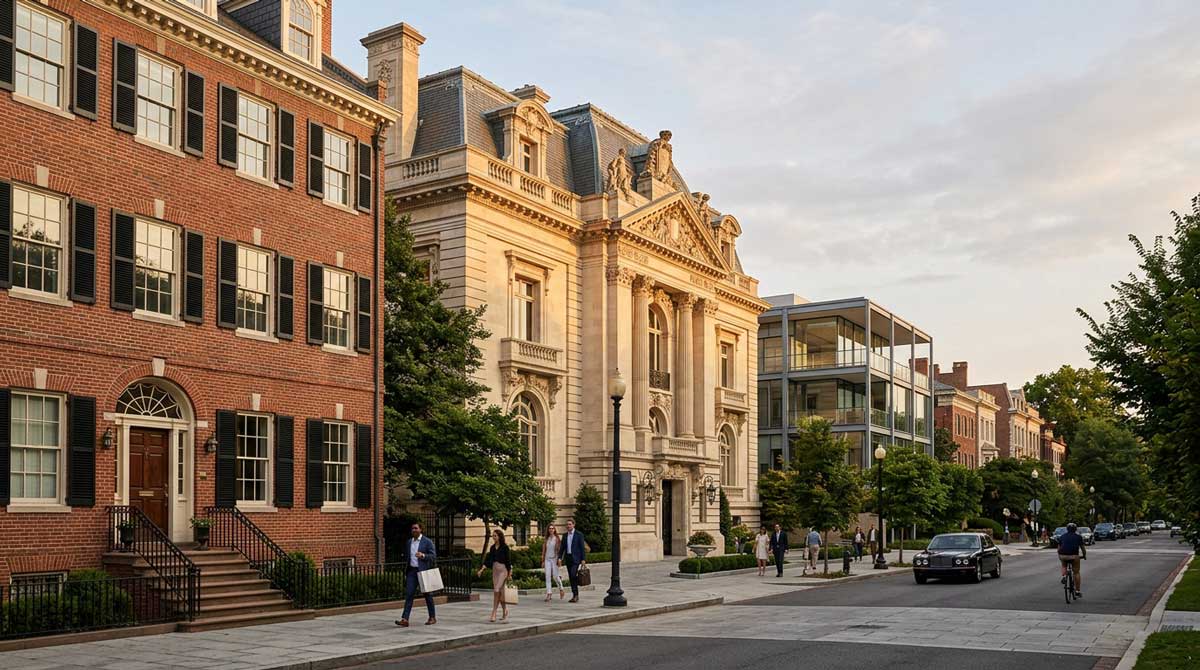
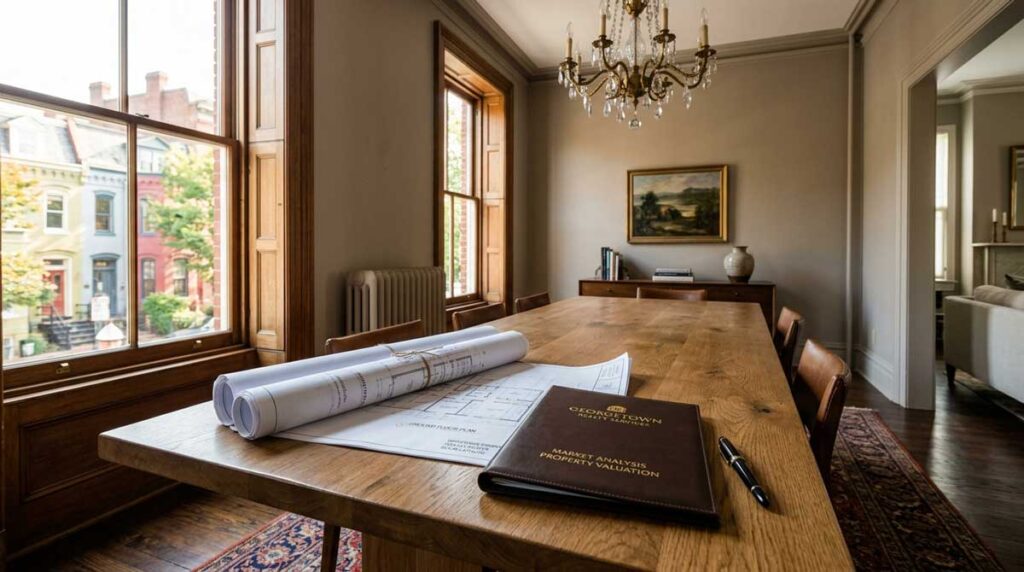
Washington DC contains the most architecturally varied residential stock of any city its size in the United States. This is a direct consequence of Pierre L’Enfant’s 1791 plan, which produced an urban form expansive enough to accommodate 230 years of evolving architectural taste without erasing what came before. A single block in Capitol Hill can hold Federal townhouses from 1820, Italianate rowhouses from 1875, and Colonial Revival infills from 1925, each contributing to a streetscape that no other American city quite matches.
Understanding which style a home belongs to matters for interior design. Style shapes what a renovation can change, what it should preserve, and what design language reads as correct against the building’s own grammar. What follows is a designer’s field guide to the six architectural traditions that define DC’s residential character: what each looks like, where each is found, and how interior design responds to each.
Federal Style (1780 to 1820)
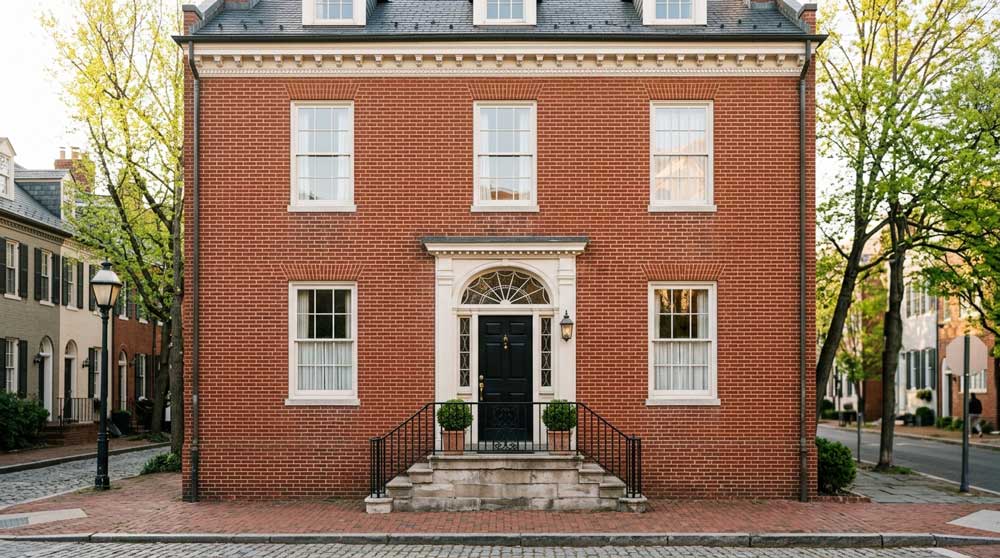
Federal-style buildings define old Georgetown and the oldest sections of Capitol Hill. The style emerged from the post-revolutionary American interpretation of British Adam-style classicism, refined down to a restrained, symmetrical language emphasizing slender proportions and delicate ornament. The Federal period in DC coincides almost exactly with the founding decades of the federal city itself.
Defining features. Red brick facades in Flemish bond. Symmetrical five-bay or three-bay elevations. Six-over-six double-hung windows with thin muntins. Semicircular or elliptical fanlight transoms above front doors. Delicate cornices with dentil molding. Shallow stoops with iron railings. Interior detailing stays restrained: simple chair rails, narrow crown moldings, six-panel doors, fireplace surrounds with reeded pilasters or marble facing.
Designing for a Federal home means working with the period’s restraint, not against it. Honor the symmetry. Wall colors that flatter the original moldings (creams, sage greens, putty grays, oxblood) outperform contemporary palettes that fight the building’s vocabulary. Federal-era homes have lower ceilings and smaller rooms than buyers often expect, so scaling furniture to the rooms (rather than imposing oversized contemporary pieces) produces better results.
Greek Revival and Italianate (1820 to 1880)
As the city expanded north and east in the mid-19th century, two related styles dominated residential construction. Greek Revival (1820 to 1850) replaced Federal restraint with classical grandeur: heavier proportions, full entablatures, pedimented door surrounds, and occasional full porticos. Italianate (1850 to 1880) followed, introducing tall, narrow windows with heavy hood moldings, deep bracketed cornices, low-pitched roofs, and the elaborate ornament that defines so much of Logan Circle, Dupont Circle, and Shaw today.
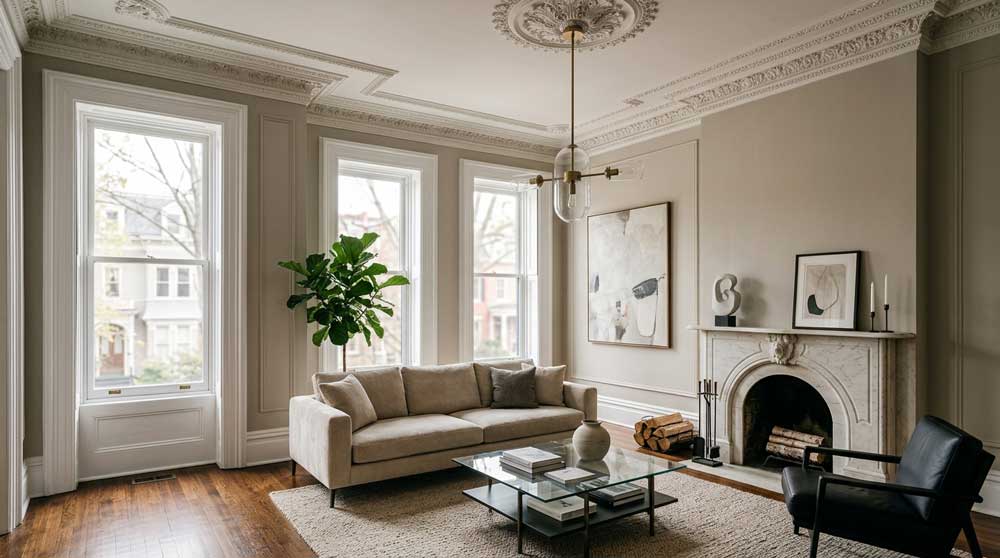
Italianate rowhouses are the building block of much of inner-city DC. They rise three or four stories, present narrow brick or painted-brick facades, and step back from the street with cast-iron-fenced front gardens. Interiors run toward the formal. High ceilings (10 to 11 feet on the parlor level is typical), elaborate plaster crown moldings, deep window casings, parlor doors with original transoms.
The interior design opportunity in Italianate properties is significant. The bones (ceiling height, room proportions, architectural detailing) give designers a great deal to work with. Successful contemporary interiors in Italianate rowhouses keep and restore original moldings, ceiling medallions, and floors, then introduce modern furniture, lighting, and art deliberately against that historic backdrop. This is the style where the gap between a beautiful renovation and an awkward one runs widest. The architecture demands either real engagement or honest neutrality, never half-measures.
Queen Anne and Romanesque Revival (1880 to 1900)
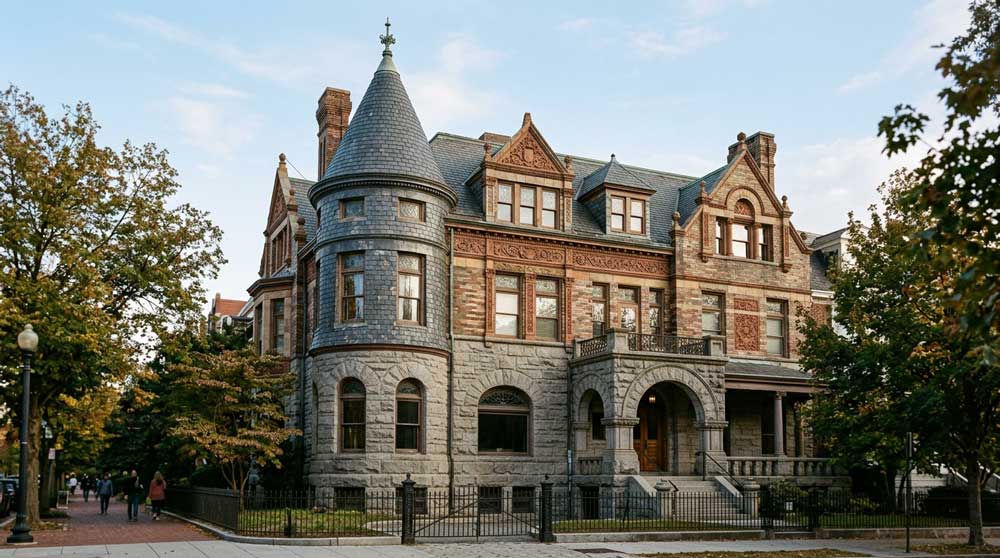
The late Victorian period in DC produced some of the city’s most architecturally exuberant residential buildings. Queen Anne style introduced asymmetry, tower features, multiple competing materials (brick, stone, wood shingle, terra cotta), polychromatic facades, and turreted corners. Romanesque Revival contributed massive rough-cut stone, round-arched openings, and the sense of permanence that defines Kalorama Heights, parts of Mount Pleasant, and pockets of Dupont Circle.
These homes were built large. Four to five stories. Often standalone or end-of-row positions on prominent lots. Interior spaces include octagonal turret rooms, double parlors with sliding pocket doors, grand staircases with elaborate newel posts, and stained-glass windows. Original floor plans often have a formality that does not match modern living patterns.
Designing for late-Victorian properties is the most challenging style assignment in the District. The architecture is so ornamented and so formally configured that contemporary minimalism rarely succeeds. Period-appropriate restoration can feel oppressive to modern occupants. Successful contemporary interiors in these properties work through editing: keep the most significant original features (staircase, parlor moldings, turret room) while quieting secondary details that compete for attention.
Beaux-Arts (1890 to 1920)
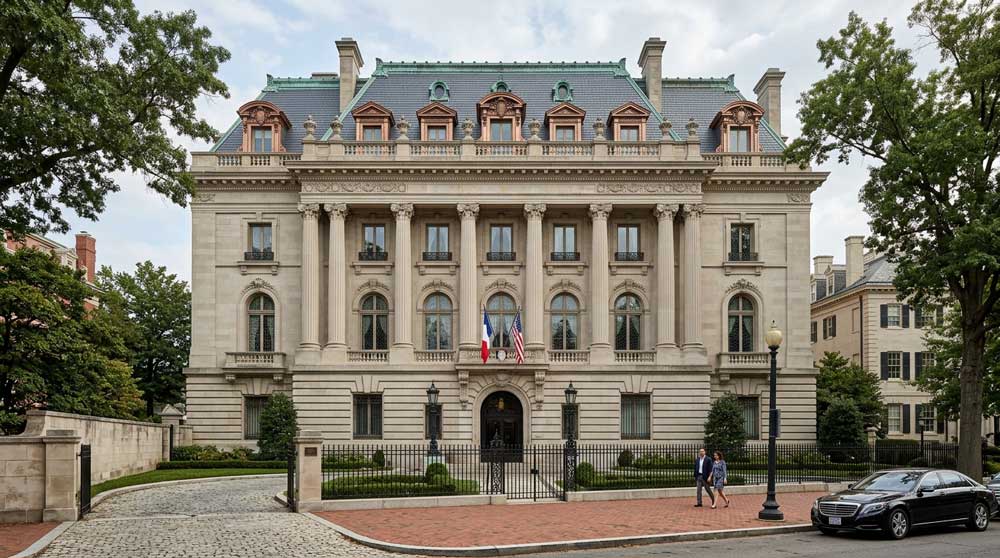
Beaux-Arts is the style most identified with monumental Washington. The Library of Congress. Union Station. Many of the embassies along Massachusetts Avenue. In residential architecture, Beaux-Arts produced the grand mansions of Embassy Row, Dupont Circle, Kalorama, and Sheridan-Kalorama. The style imported French academic classicism wholesale: paired columns, heavy rusticated stone bases, mansard roofs, elaborate cornices, oval ballrooms, and rooms organized around grand processional axes.
These buildings were designed for entertaining at scale and for the diplomatic and political life of late-Gilded-Age Washington. Interior volumes are unusual. Ceiling heights of 14 to 16 feet in the principal rooms. Doorways aligned through entire floors (enfilades). Interior courtyards. Back-of-house service wings that often equal the size of the public rooms.
Beaux-Arts residential interior design is its own design discipline. The architecture’s formality demands corresponding formality in materials, scale, and arrangement. Contemporary art and furniture can work brilliantly in these spaces precisely because the architecture is so emphatic. Anything quieter than the architecture risks disappearing. Anything competing with it risks chaos. The most successful contemporary interiors in DC Beaux-Arts mansions deploy a confident editorial hand, using contemporary work as deliberate counterpoint to the building’s classical language.
Colonial Revival and Tudor Revival (1900 to 1940)
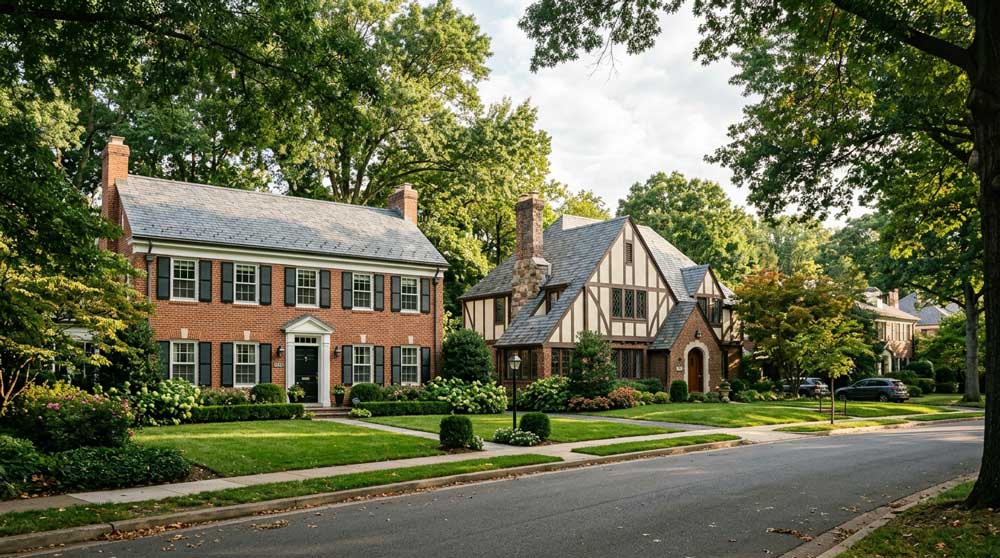
The early 20th century saw DC’s residential expansion into the streetcar suburbs that became Chevy Chase, Cleveland Park, Tenleytown, Forest Hills, and parts of Northwest. Two related revival styles dominated. Colonial Revival reinterpreted Federal and Georgian American architecture for a 20th-century audience. Tudor Revival imported English half-timbered medievalism. Both emphasized comfort and domestic warmth, a shift from the formal grandeur of earlier periods.
Colonial Revival homes feature symmetrical brick facades, multi-pane double-hung windows with shutters, classical entry porticos, and balanced interior plans organized around a center entry hall. Tudor Revival homes are asymmetrical, with steeply pitched gabled roofs, half-timbering above stucco or brick, leaded casement windows, and prominent chimneys.
The interiors of these revival homes are the most flexible canvas in DC’s residential stock. The architecture suggests rather than demands a particular design direction. Contemporary, transitional, and traditional approaches all work. Choices come down to the homeowner’s preferences more than the building’s insistence. Most kitchen and bathroom renovations in these properties involve substantial reconfiguration. Original kitchens were small. Master baths often did not exist.
Mid-Century Modern and Later 20th Century (1945 to 1980)
Modernism’s residential presence in DC is concentrated and excellent. Forest Hills holds the largest cluster of mid-century modern homes in the District, with significant examples scattered through upper Northwest, Chevy Chase DC, and Spring Valley. The style introduced low horizontal massing, flat or shallow-pitched roofs, walls of glass, open floor plans, and an architectural language of structure-as-ornament rather than applied detail.
Designing for mid-century modern homes is a particular discipline. The architecture’s clarity demands respect. Added ornament feels wrong. Period revivals feel wrong. Contemporary moves that match the original design philosophy feel right. Furniture from the mid-century period itself (Knoll, Herman Miller, Saarinen, Eames) and contemporary work in that lineage reads as correct. Color palettes lean toward warm neutrals, deep blacks, walnut and teak wood tones, with deliberate accent points of intense color.
Renovations to mid-century modern homes face a particular tension. The original kitchens and bathrooms are typically inadequate by current standards, but obvious modernization erodes the architecture. The most successful interventions design new spaces in the original spirit (open, structural, material-driven) rather than imposing contemporary alternatives that visually fight the rest of the house.
Why style matters for interior design decisions
Across all six traditions, the same principle holds. Interior design that engages thoughtfully with the building’s architectural language outperforms design that ignores it. This does not require period-perfect restoration. Contemporary work in historic envelopes can be exceptional. What it requires is accurate reading of what the architecture is doing, and deliberate choices about how to respond.
At Arch & Handle, the architectural reading of the property is the first step in every residential project. Whether the building is a Federal rowhouse in Georgetown, an Italianate in Logan Circle, a Beaux-Arts mansion in Kalorama, or a mid-century modern in Forest Hills, the design approach starts with understanding what the building already is. Our residential interior design service is built around this principle, and our architecture services bring the same approach to additions, renovations, and new construction in DC’s historic neighborhoods.
Working with a historic DC property?