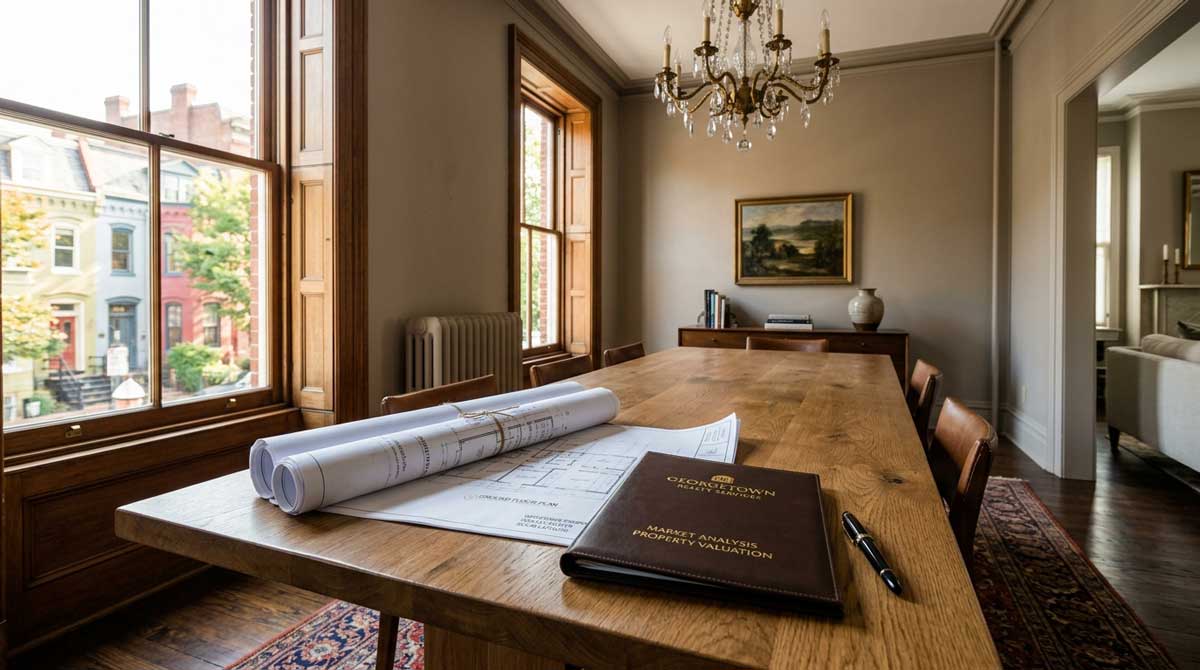
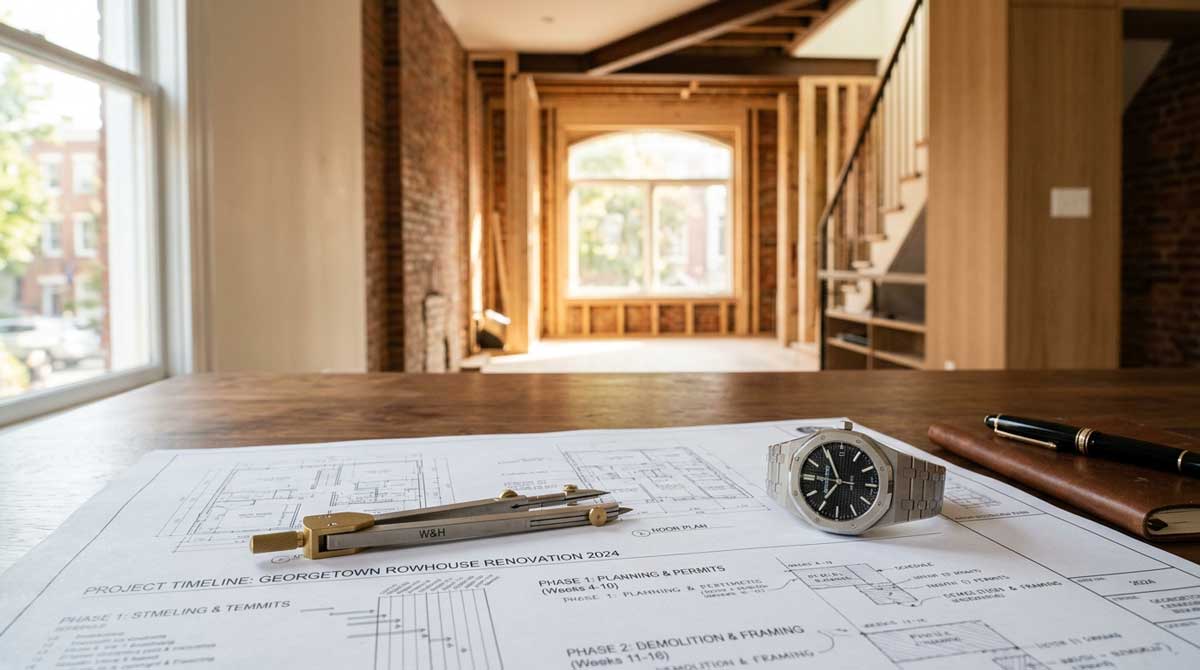
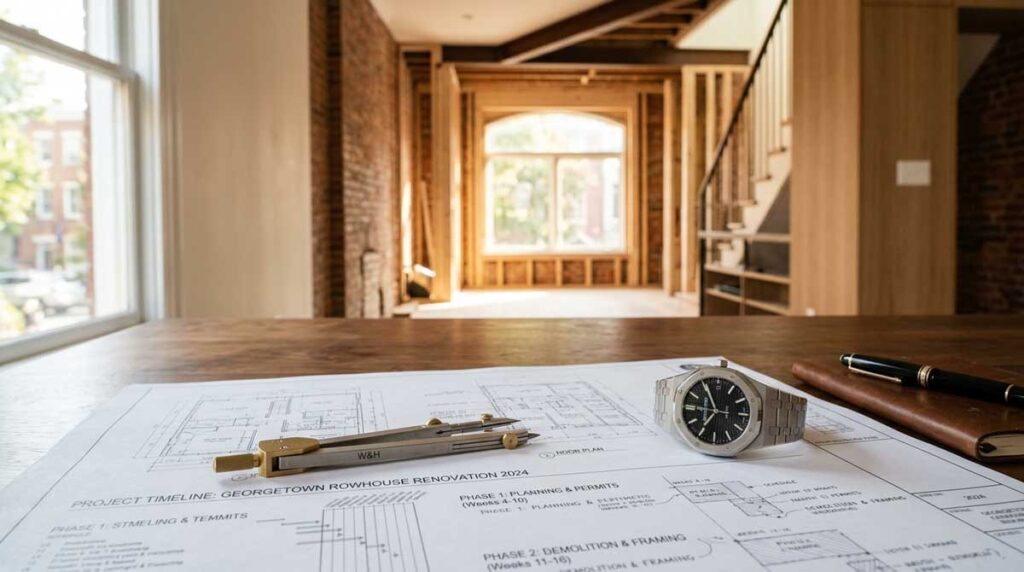
Every few years, most Washington DC homeowners face the same question: stay and renovate, or sell and move? There is no universal answer. The right call depends on the math, the lifestyle factors, and the emotional weight of the specific home and neighborhood involved. What follows is a structured framework for working through the decision deliberately, instead of defaulting to whichever option feels easier in the moment.
The framework breaks the decision into four sequential questions. Work through them in order. By the end, the right answer for your situation should be clear, or at least the next question worth investigating will be obvious.
Question 1: What does the financial math actually say?
In Washington DC’s current housing market, the breakeven between renovating and moving generally falls around 30 to 40 percent of the home’s current value in renovation cost. Below that threshold, renovation usually wins on pure economics. Above it, moving often becomes more rational, though the answer also depends on what you are renovating, what you would be moving to, and how long you plan to stay.
To run the comparison properly, gather these numbers:
- Current home value (pull a recent CMA from a local agent, not Zillow)
- Estimated renovation cost (your designer should give you a range, not a single number)
- Cost of a comparable home meeting your improved-needs criteria
- Estimated transaction costs of selling and buying (8 to 12 percent of combined transaction values is typical)
- DC transfer and recordation taxes (2.9 percent on the buy side for owner-occupants on properties over $400k as of 2026)
- Capital gains exclusion eligibility ($250k single or $500k married, with ownership plus occupancy 2 of the last 5 years)
The most common mistake: forgetting transaction costs. Selling a $1.5M home and buying a $2M home in DC’s current market easily consumes $200k to $280k in commissions, taxes, and closing costs before a single dollar of improvement reaches the new property. A $250k renovation that addresses your actual concerns is often cheaper than moving, even when the moving option looks more attractive on the surface.
What renovation actually costs in DC depends heavily on scope. Our overview of residential design services covers typical project scope and approach. For closer detail on specific project economics, our cost-focused content (in development) breaks down kitchen, bathroom, and whole-home budgets for the District.
The ranges above reflect projects where homeowners work with a design-integrated firm. Renovations split across separate architects, designers, and general contractors run 20 to 40 percent longer. Why? Coordination friction. Every phase boundary becomes a handoff. Every handoff becomes a delay. For more on integrated design and construction, see our overview of our renovation services and the residential design process.
Question 2: What problem are you actually trying to solve?
Most renovation-versus-move decisions get framed around space. “We need more bedrooms.” “The kitchen is too small.” “There is nowhere to work from home.” But the underlying need is rarely just square footage. Distinguishing surface symptoms from root needs matters, because the two paths solve different problems.
Renovation solves layout problems, finish problems, function problems, and capacity problems. These are problems where the bones of the property support what you actually need, and the surrounding context (neighborhood, commute, schools, walkability) is what you want it to be.
Moving solves something different. Location problems. Neighborhood problems. School problems. Structural-limitation problems. These are problems where no amount of internal change addresses what you really want to fix.
If your honest answer to “what would actually be different” focuses mostly on the inside of the house, renovation deserves serious consideration. If your honest answer involves the block, the commute, the schools, or some structural reality the property cannot change, moving may be the better path regardless of the math.
Question 3: Does your home support the renovation you would need?
Not every house can be renovated into what its owners want it to be. Constraints worth honestly assessing before committing to renovation:
Structural limits. Load-bearing walls, foundation conditions, ceiling heights, lot coverage maximums, and zoning setbacks all constrain what is actually possible. A skilled architect can confirm what is feasible after a site visit. Many imagined renovations turn out to be impossible or financially impractical once constraints get mapped.
Historic district restrictions. Properties in Georgetown, Capitol Hill, Mount Vernon Triangle, Kalorama, Strivers’ Section, LeDroit Park, and DC’s other historic neighborhoods fall under Historic Preservation Review Board (HPRB) oversight. This can extend timelines, narrow design options, and occasionally make certain renovations effectively unworkable. Exterior changes, window replacements, and rear additions affecting the streetscape are the most commonly constrained.
Condo and HOA limitations. Condo bylaws and HOA documents restrict scope in ways homeowners often underestimate. Wet wall locations, structural penetrations, and common-element impacts are usually constrained. Some condos forbid the kinds of renovations buyers most want to make.
Sunk-cost economics. If the property has been renovated once already and the prior work does not match what you would want now, you are effectively renovating twice. You are paying to undo previous work before paying for new work. In these cases, the renovation math often crosses the threshold where moving becomes more rational.
Question 4: How long do you plan to stay?
The time horizon question rules many renovation decisions out. Planning to leave within 3 to 5 years? Most major renovations do not recover their cost at sale. Cosmetic improvements (paint, hardware, lighting, refinishing) recover well. Structural and reconfiguration work rarely does in that timeframe. The exception is a kitchen renovation, which in DC’s market recovers 70 to 85 percent of cost at resale even within shorter timeframes.
Planning to stay 7 or more years? Renovation economics shift dramatically. A renovation costing $300,000 amortized over 10 years is $2,500 per month for a home shaped to your actual life. That is competitive with the carrying cost difference between staying put and moving to a $500,000-more-expensive property.
Planning to stay 15 or more years? Almost every renovation that addresses real needs makes sense, regardless of immediate ROI math. At that horizon, the property is being shaped for use, not for resale.
Putting the four questions together
Four “renovate” indicators? Renovate with confidence. Four “move” indicators? List the property. Mixed signals? That is the case actually worth talking through with both an architect and a real estate agent before committing either direction.
When the framework does not give you a clear answer
Some situations resist clean answers. Usually when a beloved home in the right neighborhood has structural constraints that make the ideal renovation difficult, or when the family’s needs are evolving faster than the math can settle. In these cases, the right next step is usually a feasibility consultation. Bring an architect in to map what is actually possible on the property before committing either direction.
A feasibility study is different from a renovation consultation. The feasibility study answers one question: “Can we accomplish what we want here, and if so, what would it cost and take?” It produces enough information to make the renovate-or-move decision on a real foundation, without committing to design fees for a renovation that turns out to be unworkable.
Considering a renovation in DC, Maryland, or Northern Virginia?
Arch & Handle conducts feasibility consultations across Washington DC, Bethesda, Alexandria, Arlington, and the wider DMV region. A two-hour site visit produces a clear picture of what is possible on your property, what it would cost, and what timeline is realistic. These are the inputs you need to make the renovate-or-move decision on solid ground. Start a conversation here to schedule a feasibility consultation